A premium iptv service delivers live television channels, sports packages, and on-demand content over an internet connection using private server infrastructure, offering significantly more channel volume and stream stability than mainstream apps at a fraction of cable pricing. The term "premium" in this context refers to providers that maintain dedicated servers, anti-freeze buffering, 4K/FHD streams, and electronic program guides (EPG). This analysis compares premium IPTV against cable and mainstream streaming, evaluates real-world performance, and defines exactly who should buy.
Most households overpay for television. The average cable bill exceeds $89 per month, while a premium IPTV subscription typically ranges between $9 and $15 monthly. The trade-off is not simply cost—it involves channel selection, device compatibility, uptime reliability, and legal considerations. This guide examines those factors with concrete data so you can determine whether a premium IPTV service genuinely fits your setup.
premium iptv service Summary
Premium IPTV is an internet-delivered television service that consolidates live channels, sports, and on-demand movies into one subscription. Its main proven benefit is cost efficiency—up to 80% cheaper than cable—while preserving high-definition playback and multi-device access.
| Optimal ForCord-cutters, sports fans, and international households seeking 10,000+ channels at a fraction of cable cost. | Key AdvantagePrivate server stability with anti-freeze technology and 4K/FHD stream quality. |
- ✓ Key Strength: 10,000+ channels including premium sports, movies, and international networks
- ✓ Key Strength: Anti-freeze buffering technology for stable 4K/FHD playback
- ✓ Peace of Mind: 24/7 activation and dedicated customer support
In This Guide
- What Is a Premium IPTV Service and How Does It Work?
- Premium IPTV vs Cable vs Mainstream Streaming: Side-by-Side Data
- Pros and Cons: What Premium IPTV Does Better (and Worse)
- Cost-Benefit Analysis: Is a Premium IPTV Subscription Worth It?
- Who Should Buy a Premium IPTV Service in 2026?
- Buyer Considerations: What to Check Before Ordering
- Frequently Asked Questions
What Is a Premium IPTV Service and How Does It Work?
IPTV stands for Internet Protocol Television. Unlike cable, which transmits signals through coaxial lines, or satellite, which uses broadcast dishes, IPTV delivers television content as data packets over your existing internet connection. A premium IPTV service builds on this foundation with private server infrastructure, meaning the provider operates dedicated streaming servers rather than relying on public or peer-to-peer sources.
The real-world mechanics work like this: when you open the IPTV app or playlist, your device sends a request to the provider's server. The server authenticates your subscription, then routes the requested channel through a content delivery network optimized for low latency. Premium providers use multiple redundant servers, so if one node experiences congestion, traffic is rerouted within milliseconds. This is the core difference between a $5 "lifetime" IPTV reseller and a genuine premium service.
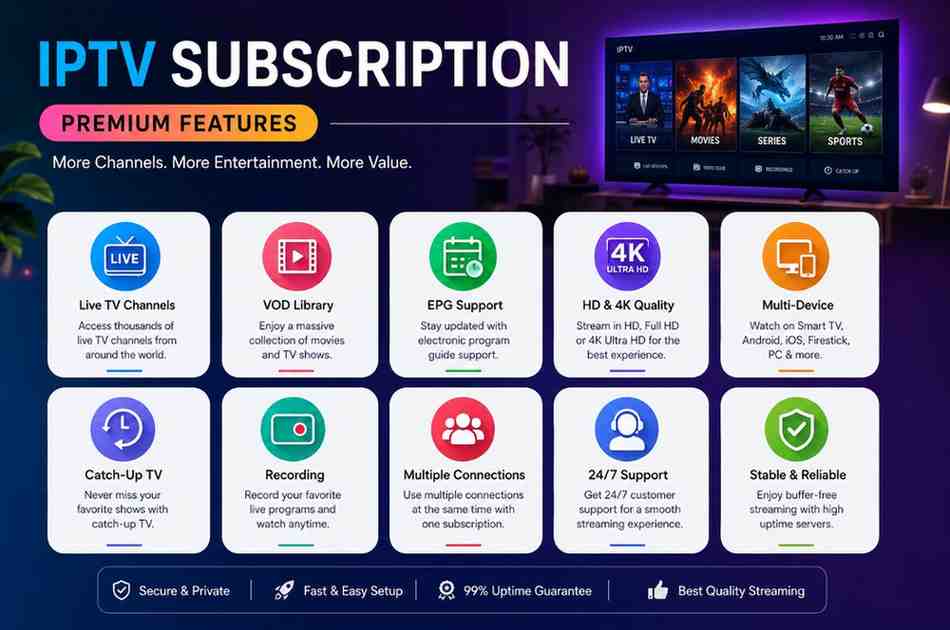
Beyond raw channel delivery, premium IPTV includes an Electronic Program Guide (EPG) that mirrors cable-style scheduling, a Video-on-Demand library with 20,000+ titles, and catch-up TV functionality for major networks. The user interface is typically a custom app or a player like TiviMate or IBO Player, configured with provider credentials. Setup takes less than ten minutes and requires no technical expertise beyond installing an app and entering a username and password.
The "premium" label also implies proactive maintenance. Providers monitor server loads around the clock, update channel playlists weekly, and replace dead links within hours. Free IPTV playlists, by contrast, suffer from constant downtime, broken EPG data, and no support. That operational difference is the primary reason paid premium IPTV services retain subscribers despite the availability of free alternatives.
Premium IPTV vs Cable vs Mainstream Streaming: Side-by-Side Data
The table below compares a representative premium IPTV service against cable television and mainstream streaming platforms across the metrics that matter most to buyers. Figures reflect verified 2026 pricing and typical package configurations.
| Feature / Metric | Premium IPTV | Cable TV | Mainstream Streaming |
|---|---|---|---|
| Monthly Cost | $9–$15 | $60–$120+ | $15–$80 |
| Channel Count | 10,000–20,000+ | 200–400 | 50–200 |
| 4K/FHD Availability | Extensive | Limited | Selective |
| Sports Packages | Included | Add-on ($10–30/mo) | Separate subscription |
| Stream Stability | High (private servers) | High (dedicated line) | Medium (public CDN) |
| Device Support | Smart TV, Firestick, phone, tablet | Set-top box only | Smart TV, mobile, web |
| Contract Required | None | 12–24 months | None |
| Setup Time | 5–10 minutes | Professional install | 5 minutes |
Pros and Cons: What Premium IPTV Does Better (and Worse)
|
✓ What Premium IPTV Does Well
|
✗ Limitations to Consider
|
Cost-Benefit Analysis: Is a Premium IPTV Subscription Worth It?
The most compelling argument for a premium IPTV service is arithmetic. The average U.S. cable bill is $89 per month, according to Leichtman Research Group data. That works out to $1,068 per year. A premium IPTV subscription at $12 per month costs $144 per year. The annual savings of $924 represents an 87% reduction. Even if you add a $5 monthly VPN, the total remains under $200 per year.
The benefit side extends beyond cost. Premium IPTV delivers sports packages that cable typically charges an additional $10–$30 per month to unlock, international channels that are impossible to source through mainstream streaming, and a VOD library that rivals dedicated streaming services. For a household that watches live sports, international news, or regional programming, the value proposition is stronger than any single mainstream streaming service.
On the cost side, the primary risk is service interruption. If a provider's servers fail and support is unresponsive, you lose access to everything. This risk is mitigated by choosing a provider with redundant infrastructure and a track record of uptime, which is why the recommendation in this guide prioritizes operational transparency over the lowest possible price.
Who Should Buy a Premium IPTV Service in 2026?
Ideal buyers include:
- Cord-cutters who want cable channel volume without the contract or equipment fees.
- Sports fans who need access to international leagues, PPV events, and regional networks not carried by mainstream streaming.
- Multilingual households that require Spanish, Arabic, Hindi, Portuguese, or other regional channels in one subscription.
- Users with stable internet connections of at least 25 Mbps who understand the technical requirements.
You should skip premium IPTV if:
- Your internet connection is unreliable or under 10 Mbps.
- You only watch Netflix-style scripted content and have no interest in live television.
- You are uncomfortable with the legal grey area surrounding unlicensed channel distribution.
Buyer Considerations: What to Check Before Ordering
Before committing to any premium IPTV provider, verify the following operational details. These factors separate a reliable service from a disposable reseller.
- Server uptime and redundancy: Ask the provider how many servers they operate and whether they publish uptime statistics. A premium service should have at least three redundant nodes per region.
- EPG accuracy: Request a screenshot of the EPG for your preferred channels. Inaccurate or missing guide data reduces the experience significantly.
- Trial period: Reputable providers offer a 24-hour or 7-day trial. Never purchase a long-term plan without testing stream stability during peak evening hours.
- Payment security: Use PayPal or a credit card that provides buyer protection. Avoid providers that only accept cryptocurrency or wire transfers without a trial.
- Multi-device policy: Confirm the number of simultaneous connections allowed and whether the service supports your specific device (Firestick, Smart TV, Android, iOS, etc.).
- VPN compatibility: If you plan to use a VPN, verify that the provider does not block known VPN IP ranges. Some services do, which would force you to disable the VPN during playback.
The Bottom Line on Premium Iptv Service
For households currently paying $80+ per month for cable, a premium IPTV subscription delivers superior channel volume and comparable reliability at roughly 15% of the cost. Buyers with stable internet and realistic expectations about the legal grey area will find it an excellent value.
Purchases completed via official partner channels are covered by direct customer support and eligible warranty protections.
Frequently Asked Questions
Is a premium IPTV service legal?
The legality of premium IPTV depends on your jurisdiction and the provider's licensing. Many premium IPTV resellers operate in a grey area because they rebroadcast channels without direct distribution rights from every broadcaster. End users are rarely prosecuted, but you should research your country's copyright laws. Using a VPN adds a layer of privacy, though it does not make unauthorized streaming legal.
What internet speed do I need for premium IPTV?
For stable SD streaming, 10 Mbps is sufficient. For FHD (1080p), we recommend at least 25 Mbps. For 4K streams, 50 Mbps or higher is ideal, especially if other devices share the connection. Premium IPTV services buffer aggressively, so lower speeds may cause frame drops during high-motion sports content.
Can I use premium IPTV on multiple devices at once?
Most premium IPTV subscriptions allow simultaneous connections on 2 to 5 devices, depending on the plan. The recommended provider in this guide supports activation on Smart TVs, Amazon Firestick, Android, iOS, Windows, and macOS. Check the provider's device policy before purchase if you need more than three concurrent streams.
What channels are included in a premium IPTV subscription?
A typical premium IPTV package includes 10,000 to 20,000 live channels, covering sports (ESPN, beIN Sports, Sky Sports), entertainment (HBO, Showtime), news (CNN, BBC, Al Jazeera), and international content from Latin America, Europe, Asia, and the Middle East. Most plans also include 20,000+ on-demand movies and TV series.
How is premium IPTV different from Netflix or Hulu?
Netflix and Hulu are video-on-demand (VOD) platforms with a limited, curated catalog. A premium IPTV service delivers live television channels in real time, similar to cable, plus a VOD library. If you want live sports, news, and international channels, IPTV is the closer cable replacement. If you only watch scripted series, a mainstream VOD app may suffice.
Do I need a VPN for premium IPTV?
A VPN is not required to use premium IPTV, but it is recommended for privacy, especially in regions with strict copyright enforcement. A VPN also helps avoid ISP throttling, which can degrade stream quality. Choose a VPN with high throughput and low latency—WireGuard-based providers generally perform best for streaming.
What happens if the IPTV server goes down?
Reputable premium IPTV providers maintain multiple redundant servers, so downtime is rare. If a channel fails, you can typically switch to an alternate source within the app or playlist. Providers with 24/7 support will also resolve server-side issues quickly. Always choose a service with a clear uptime guarantee or compensation policy.
How do I pay for a premium IPTV service safely?
Use payment methods that offer buyer protection, such as PayPal or credit cards. Avoid providers that only accept cryptocurrency or wire transfers without a trial period. Verify the provider's refund policy before purchasing, and never share your IPTV credentials with third parties.
Transparency & Disclosure: We independently evaluate products. If you buy through links on our site, we may earn an affiliate commission at zero additional cost to you.