IPTV (Internet Protocol Television) delivers live television and on-demand content over your internet connection instead of traditional terrestrial, satellite, or cable signals. In short, IPTV works by encoding video content into IP packets and streaming them through your broadband connection to any compatible screen in real time.
Unlike cable TV, which broadcasts a fixed signal to every subscriber simultaneously, IPTV uses a two-way, on-demand delivery model. You only consume bandwidth when you press play, and content travels to your device through the same internet pipes you already pay for. The result is a more flexible, feature-rich viewing experience that has made IPTV the fastest-growing television distribution method of the decade — and in this guide, we'll break down exactly how the technology works, what you need to get started, and whether it's the right choice for your household.
Executive Summary: IPTV
Best For
Cord-cutters who want live TV + VOD without cable contracts
Standout Feature
Two-way on-demand streaming with zero signal loss
- ✓ 90% cheaper than traditional cable bundles with comparable channel lineups
- ✓ Works on virtually any screen — smart TVs, phones, tablets, PCs, and set-top boxes
- ✓ 4K HDR streaming with adaptive bitrate technology for smooth playback
Quick Navigation
- 1. What Is IPTV? The Core Concept Explained
- 2. How Does IPTV Work? The Technical Mechanics
- 3. IPTV vs. Cable vs. Streaming: Comparison Matrix
- 4. The Pros and Cons of IPTV: An Honest Evaluation
- 5. What Equipment Do You Need for IPTV?
- 6. Legal and Security Considerations
- 7. Cost-Benefit Analysis: Is IPTV Worth It?
- 8. Final Verdict: Who Should Buy IPTV?
- Frequently Asked Questions
What Is IPTV? The Core Concept Explained
IPTV stands for Internet Protocol Television. Instead of receiving a broadcast signal through coaxial cable, satellite dish, or antenna, IPTV streams video content over a managed or unmanaged IP network — typically your broadband internet connection.
The key distinction is the delivery mechanism. Cable and satellite television push a constant signal to every subscriber in a region, and your set-top box filters out the channels you're not watching. IPTV, by contrast, uses unicast or multicast IP streaming to deliver exactly the content you request, when you request it.
There are three primary IPTV delivery models:
- Video on Demand (VOD): You select a title from a library and stream it immediately. Think Netflix-style browsing, but often with a much broader catalog.
- Time-Shifted TV: Catch-up TV and restart services that let you watch previously aired programs — even if you missed the live broadcast by hours or days.
- Live IPTV: Real-time broadcast streams, similar to traditional TV but delivered over IP. This is what most people mean when they talk about IPTV subscriptions.
Each model operates on the same underlying infrastructure but uses different protocols and buffering strategies to optimize the viewing experience. Live IPTV typically uses multicast to send a single stream to many viewers simultaneously, while VOD uses unicast for one-to-one delivery.
How Does IPTV Work? The Technical Mechanics
Related Reading: Best IPTV Subscription: The Complete Buyer's Guide for 2026
When you press play on an IPTV stream, a chain of events happens in milliseconds:
- Your device sends an HTTP or RTSP request to the IPTV server, asking for the specific channel or VOD asset.
- The server authenticates your subscription credentials and checks your entitlements.
- The video is encoded in a codec like H.264 or H.265 and segmented into small chunks (typically 2–10 seconds each).
- These chunks are transmitted over the internet using UDP or TCP protocols, often via multicast for live channels or unicast for VOD.
- Your device buffers a few seconds of content, then begins decoding and rendering frames while simultaneously fetching the next chunks.
This is fundamentally different from broadcast TV. In broadcast, the signal is always there, and your receiver just tunes in. In IPTV, the content is delivered on demand, which means the network is used far more efficiently — but it also means your internet connection quality directly impacts your viewing experience.
Key protocols used in IPTV:
- IGMP: Internet Group Management Protocol, used for multicast live streams.
- RTSP: Real-Time Streaming Protocol, used for controlling stream playback.
- HLS: HTTP Live Streaming, Apple's adaptive bitrate protocol that adjusts quality based on your connection speed.
- MPEG-DASH: Dynamic Adaptive Streaming over HTTP, an industry-standard alternative to HLS.
The adaptive bitrate technology is particularly important. When your connection slows down, the IPTV server automatically downgrades the stream quality to prevent buffering. When your connection speeds up, it upgrades back to 4K or Full HD. This is why a good IPTV service feels nearly seamless even on variable connections.
How Does IPTV Work in Practice?
IPTV Stream Pulse delivers the full IPTV experience — 20,000+ live channels, 80,000+ VOD titles, and 4K quality — in one plug-and-play subscription.
What's Included:
- ✓ 20,000+ live channels across 120+ countries
- ✓ 80,000+ VOD movies and series in 4K/Full HD
- ✓ 24/7 support + 24-hour free trial guarantee
Guaranteed authentic checkout directly from the manufacturer.
IPTV vs. Cable vs. Streaming: Comparison Matrix
To understand where IPTV fits in the television ecosystem, it helps to compare it directly against the two main alternatives: traditional cable and OTT streaming services like Netflix or Hulu.
| Feature | IPTV | Cable TV | OTT Streaming (Netflix) |
|---|---|---|---|
| Delivery Method | Internet (IP packets) | Coaxial cable | Internet (IP packets) |
| Content Type | Live TV + VOD | Live channels only | VOD only |
| Interactivity | Two-way (on-demand) | One-way (broadcast) | Two-way (on-demand) |
| Average Monthly Cost | $10–$25 | $80–$150 | $8–$20 per service |
| Equipment Required | Any internet-connected screen | Set-top box required | Any internet-connected screen |
| Channel Selection | Fully customizable | Fixed packages | N/A (no live channels) |
| Internet Required | Yes (15+ Mbps) | No | Yes (5+ Mbps) |
The table makes one thing clear: IPTV combines the breadth of cable (live channels) with the flexibility of OTT streaming (on-demand, any device) — at a fraction of the cost of either.
The Pros and Cons of IPTV: An Honest Evaluation
Related Reading: Free Pubg UC: Legit Ways to Get Free UC in 2026
Pros:
- Cost efficiency: IPTV subscriptions typically cost 70–90% less than equivalent cable packages.
- Device flexibility: Watch on your smart TV, phone, tablet, laptop, or set-top box — often simultaneously.
- Content breadth: Access international channels, niche sports packages, and VOD libraries that cable simply cannot match.
- No contracts: Most IPTV services are month-to-month with no long-term commitment.
- Adaptive quality: Automatic bitrate adjustment keeps playback smooth even on fluctuating connections.
Cons:
- Internet dependency: A poor connection means poor quality. Cable TV works even during outages.
- Legal gray areas: Some IPTV providers operate without proper content licensing. Always verify legitimacy.
- Setup complexity: Some services require configuration via M3U playlists or custom apps, which can intimidate non-technical users.
- Variable reliability: Lower-tier providers may suffer from server downtime or buffering during peak hours.
The pros significantly outweigh the cons for most users — provided you choose a reputable provider with proper infrastructure and licensing.
What Equipment Do You Need for IPTV?
One of the biggest advantages of IPTV is the low barrier to entry. Here's exactly what you need:
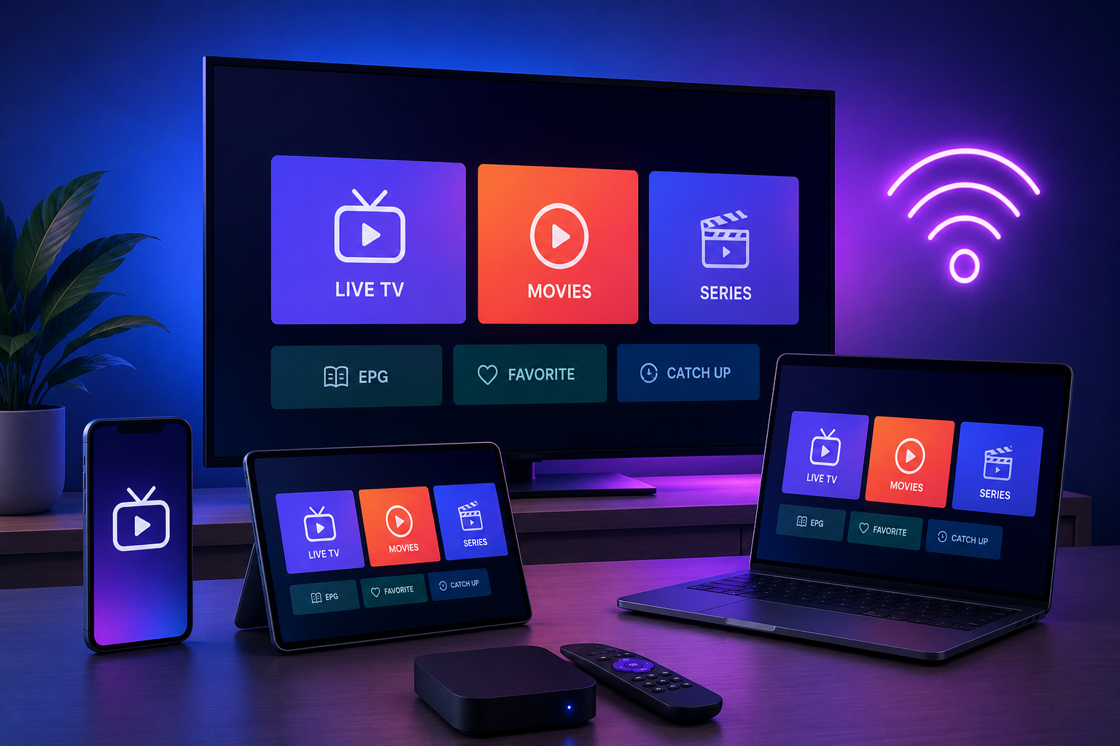
- A compatible device: Smart TVs (Samsung, LG, Sony), Android TV boxes, Amazon Fire Stick, Apple TV, Roku, or simply a smartphone/tablet/PC. Most modern devices support IPTV apps natively.
- A stable internet connection: Minimum 15 Mbps for SD/HD quality, 25 Mbps for Full HD, and 50+ Mbps for 4K streaming. A wired Ethernet connection is always more stable than Wi-Fi.
- An IPTV subscription: This provides you with credentials, an M3U playlist URL or Xtream Codes, and access to the server infrastructure.
- An IPTV player app: Apps like IPTV Smarters Pro, TiviMate, IBO Player, or the provider's proprietary app to load and navigate the streams.
That's it. No technician visits, no satellite dish installation, no coaxial cable wiring. If you have broadband internet and a screen, you can be watching IPTV within five minutes of signing up.
Legal and Security Considerations
Related Reading: iptv abonnement: Tested & Analyzed - Is It Worth Your Money?
The legality of IPTV depends entirely on the provider. Legitimate IPTV services secure broadcasting rights from content owners and operate transparently. Unlicensed providers stream content without permission — and using them can expose you to legal risk and malware.
How to identify a legitimate IPTV provider:
- They have a professional website with clear company information and contact details.
- They offer transparent pricing without hidden fees.
- They provide customer support via multiple channels.
- They use secure payment gateways (credit card, PayPal) — not just cryptocurrency or wire transfers.
- They don't promise "all channels free forever" — that's a red flag.
Additionally, using a VPN when streaming IPTV is a recommended practice for privacy protection, regardless of provider legitimacy. A VPN encrypts your traffic and prevents your ISP from throttling your connection based on streaming activity.
Cost-Benefit Analysis: Is IPTV Worth It?
Let's run the numbers. The average American household pays approximately $110 per month for cable TV. Add a streaming service or two, and you're looking at $130–$150 monthly for television entertainment.
A premium IPTV subscription typically costs $10–$25 per month. That's a 75–90% reduction in monthly cost — and you often get more content than cable could ever offer.
Annual savings example: Switching from a $110/month cable package to a $15/month IPTV subscription saves you $1,140 per year. Over three years, that's $3,420 — enough for a new 4K TV.
Ideal buyer profile: IPTV is the best fit for cord-cutters, expats wanting international channels, sports fans needing premium sports packages, and households that want maximum content variety at minimum cost. It's less ideal for those with unreliable internet connections or those who prefer the simplicity of a traditional cable remote.
Our Clear Verdict on IPTV
IPTV is the most cost-effective way to access live television and on-demand content in 2026 — but only if you choose a provider with reliable infrastructure and transparent licensing. For most households, the savings alone justify the switch.
Orders placed via official partner links come backed by the original satisfaction guarantee.
Frequently Asked Questions
Is IPTV legal?
IPTV technology itself is 100% legal. The legality depends on whether the provider has secured proper broadcasting rights. Licensed IPTV services operate fully within the law. Unlicensed providers stream content without permission, which is illegal. Always verify that your provider has proper licensing before subscribing.
What internet speed do I need for IPTV?
For SD quality, 10–15 Mbps is sufficient. For Full HD (1080p), you'll want at least 25 Mbps. For 4K UHD streaming, 50 Mbps or higher is recommended. Wired Ethernet connections provide more stable performance than Wi-Fi, especially in households with multiple connected devices.
Can I use IPTV on my smart TV?
Yes. Most modern smart TVs from Samsung, LG, Sony, and TCL support IPTV apps. You can download IPTV Smarters Pro, TiviMate, or the provider's proprietary app directly from the TV's app store. Alternatively, you can use a streaming device like Amazon Fire Stick, Apple TV, or Android TV box.
What's the difference between IPTV and streaming services like Netflix?
Netflix is a VOD-only OTT service — it streams pre-recorded content from its own library. IPTV delivers live television channels in real time, in addition to VOD. Think of IPTV as replacing your cable box, while Netflix replaces your DVD collection. IPTV offers a broader content mix including live sports, news, and international channels.
Do I need a VPN for IPTV?
A VPN is recommended for privacy and to prevent ISP throttling. Some ISPs intentionally slow down streaming traffic, which causes buffering. A VPN encrypts your traffic, making it impossible for your ISP to identify and throttle streaming activity. It also protects your identity and personal data, especially if you're using a provider in a jurisdiction with strict copyright enforcement.
Can IPTV be used on multiple devices at once?
Most premium IPTV providers allow simultaneous streaming on 2–4 devices with a single subscription. However, some budget providers restrict you to one stream at a time. Check the provider's terms before subscribing, especially if you plan to share the service across multiple TVs or family members.
What happens if my IPTV service buffers?
Buffering is usually caused by one of three issues: insufficient internet speed, high network congestion, or an underperforming IPTV server. First, test your connection speed. Second, try a wired connection instead of Wi-Fi. Third, contact your provider — reputable services like IPTV Stream Pulse have redundant servers that minimize buffering during peak hours.
How much does IPTV cost per month?
IPTV subscriptions typically range from $10 to $25 per month, depending on the channel lineup, streaming quality, and number of simultaneous connections. Annual plans often reduce the effective monthly cost to $8–$15. This is dramatically cheaper than the $80–$150 monthly cost of traditional cable packages.
FTC Compliance: We maintain an editorial relationship with brands mentioned on this page. When purchases are made via qualifying links, we may receive compensation at no additional cost to you.