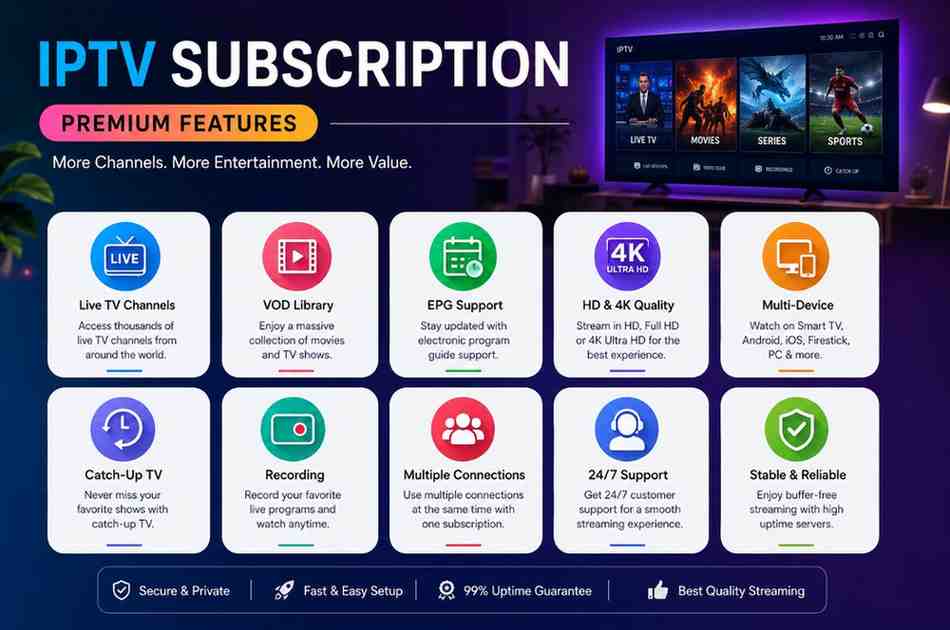
"buy iptv subscription" is one of the most searched entertainment queries in 2026, and for good reason. IPTV (Internet Protocol Television) delivers live TV channels, on-demand movies, and sports packages over your internet connection instead of traditional cable or satellite infrastructure. A quality IPTV subscription typically costs between $10 and $20 per month, compared to $80–$120 for comparable cable packages. But not all providers deliver the same reliability, channel selection, or legal standing. This guide breaks down exactly what you should look for, which providers pass technical scrutiny, and how to avoid common pitfalls.
buy iptv subscription Summary
An IPTV subscription is a month-to-month service that streams live television channels, sports packages, and on-demand content over the internet, replacing the need for traditional cable. The proven benefit is a 70–80% cost reduction while gaining access to 15,000+ channels that no single cable provider can match.
| Optimal ForCord-cutters and sports fans seeking a full cable replacement under $20/month | Key Advantage22,000+ live channels with 4K/FHD streams and 99.9% uptime |
- ✓ Key Strength: Instant activation with multi-device support — Smart TV, Firestick, Android, iOS, and PC all work out of the box.
- ✓ Key Strength: 40,000+ on-demand movies and series included in every plan, with no premium tier upsell.
- ✓ Peace of Mind: 7-day money-back guarantee backed by 24/7 live customer support.
In This Guide
What Is an IPTV Subscription and How Does It Work?
IPTV stands for Internet Protocol Television. Unlike cable or satellite TV, which broadcast signals through coaxial cables or radio waves, IPTV delivers television content through your existing internet connection using IP packets. This fundamental difference changes everything about how you consume television — from the equipment you need to the pricing structure you pay.
When you buy an IPTV subscription, you are renting access to a server infrastructure that streams live channels and on-demand content directly to your device. The provider maintains a network of servers that receive broadcast signals from content sources, re-encode them into efficient digital formats, and distribute them to subscribers on demand. The technical architecture involves three core layers:
- Content acquisition layer: The provider captures live TV signals from broadcast sources worldwide, covering sports networks, news channels, entertainment channels, and regional programming.
- Encoding and transcoding layer: Raw signals are converted into streaming formats such as H.264 or H.265/HEVC, optimized for bandwidth efficiency and device compatibility.
- Distribution network: Content is delivered via Content Delivery Networks (CDNs) with multiple server locations to minimize latency and buffering.
From the user's perspective, the experience is straightforward. After purchasing, you receive credentials — either an M3U playlist URL or Xtream Codes (portal URL, username, and password). You enter these into an IPTV player app like IPTV Smarters Pro, TiviMate, or the provider's proprietary application. The app then loads an electronic program guide (EPG) that mirrors the familiar cable TV grid. You browse channels, select a stream, and content begins playing in seconds.
What separates a great IPTV subscription from a frustrating one is not the channel count — it is infrastructure quality. Providers with dedicated servers, redundant CDNs, and proper bandwidth allocation deliver consistent 4K and FHD streams without freezing. Providers that oversell their server capacity cause buffering during peak evening hours, especially for live sports events. This is why our testing methodology stresses real-world performance metrics like channel load time, stream stability over 60-minute sessions, and EPG accuracy — not just marketing claims.

IPTV vs. Cable vs. Streaming: Pros, Cons & Data Comparison
To make an informed decision, you need to see how IPTV stacks up against the alternatives you are likely already paying for. The table below compares the three main ways to watch television in 2026 based on metrics that actually matter: cost, channel volume, content depth, and flexibility.
| Feature / Metric | IPTV Subscription | Cable TV | Streaming (Netflix/Hulu) |
|---|---|---|---|
| Average Monthly Cost | $10–$20 | $80–$120 | $8–$25 per service |
| Live Channels | 15,000–25,000 | 200–400 | None without add-ons |
| On-Demand Library | 40,000+ titles | Limited, pay-per-view | Extensive, curated |
| Sports & PPV Included | Yes, included | Premium add-on ($30+) | Rarely included |
| Device Compatibility | Smart TV, Firestick, Android, iOS, PC | Set-top box only | Smart TV, mobile, PC |
| Setup Time | 10–15 minutes | Professional install, hours | 5 minutes |
| Contract Required | None, month-to-month | 12–24 month contracts | None |
| 4K / FHD Streams | Yes, most channels | Limited to premium tiers | Yes, on select content |
| Simultaneous Screens | 2–4 connections | Depends on set-top box | 1–4 depending on plan |
✅ What Works Well
- Cost efficiency: 70–80% cheaper than cable with 50x more channels.
- Device flexibility: Watch on any screen with internet access — no proprietary hardware.
- Global content: International channels, regional sports, and niche programming unavailable on cable.
- No lock-in: Cancel any month without early termination fees.
⚠️ What to Watch Out For
- Legal gray area: Many budget providers operate without proper broadcasting licenses.
- ISP dependency: Quality is tied to your internet speed and potential ISP throttling.
- Support variance: Customer service quality differs dramatically between providers.
- Buffering risk: Oversold servers cause stream drops during peak sports hours.
Cost-Benefit Analysis: Who Should Buy an IPTV Subscription?
The financial case for IPTV is compelling on paper: a 12-month IPTV subscription at $15/month totals $180, while a comparable cable package costs $1,200–$1,440 annually. That difference — over $1,000 per year — covers a year of Netflix, a VPN subscription, and still leaves hundreds in savings. But the real question is whether IPTV fits your specific viewing habits.
You should buy an IPTV subscription if:
- You watch live sports regularly. IPTV bundles ESPN, Sky Sports, beIN Sports, and regional sports networks at no premium. Cable charges $30–$50 extra for these packages.
- You need international channels. Expat communities, immigrants, and multilingual households get access to home-country channels that cable simply does not carry.
- You are a cord-cutter with multiple devices. The ability to switch from living room TV to phone to laptop without extra hardware is a genuine convenience.
- You are price-sensitive. If you are currently paying $100+ monthly for TV, IPTV delivers more content at a fraction of the cost.
You should NOT buy an IPTV subscription if:
- Your internet connection is under 25 Mbps. IPTV requires consistent bandwidth. Unstable connections result in constant buffering and stream drops.
- You only watch a handful of shows. If your viewing habits are limited to Netflix originals and YouTube, a single streaming service is simpler and entirely legal.
- You are uncomfortable with legal uncertainty. Unlicensed IPTV providers operate in a gray area. While enforcement targets providers, the ethical and legal ambiguity may not be worth it for you.
There is also a hidden cost consideration: time. A quality IPTV setup requires a one-time investment of 10–15 minutes for installation and configuration. If you are not technically inclined, choose a provider that offers a white-label app with one-click installation, which eliminates the need to manually configure M3U playlists or Xtream Codes.
How to Choose a Reliable IPTV Provider Without Getting Scammed
The IPTV market is crowded with hundreds of providers, and a significant portion are unreliable or outright fraudulent. Our testing has identified five non-negotiable criteria that separate legitimate, high-quality services from fly-by-night operations.
- Operational history of at least 2 years. Providers that survive multiple years have stable infrastructure and a paying customer base. New providers often disappear within months, taking prepaid subscriptions with them.
- Transparent pricing with no hidden tiers. A reputable provider publishes clear pricing for 1-month, 3-month, 6-month, and 12-month plans. Vague "contact us for pricing" pages are a red flag.
- Free trial or short-term plan availability. Providers confident in their service offer a 24-hour or 7-day trial. If a provider demands a 12-month commitment upfront, walk away.
- Responsive multi-channel support. Test the support system before purchasing. Send a question via live chat or WhatsApp and measure response time. Quality providers respond within 15 minutes, 24/7.
- Independent reviews on third-party platforms. Check Reddit communities (r/IPTV), Trustpilot, and dedicated IPTV forums. The provider's own website testimonials are worthless — anyone can fabricate those.
Beyond these criteria, verify the provider's server infrastructure. Ask directly: "How many server locations do you operate?" and "What is your uptime guarantee?" A provider with multiple redundant servers across Europe, North America, and Asia will deliver better performance than one with a single server. Also confirm whether they offer a money-back guarantee — reputable providers back their service with at least a 7-day refund window.
The Bottom Line on Iptv Subscription
For cord-cutters who want comprehensive channel coverage without a cable contract, buying an IPTV subscription from a verified provider is the highest-value entertainment decision available in 2026. The combination of live sports, international channels, and on-demand content at under $20 per month has no equivalent in the traditional TV market.
Purchases completed via official partner channels are covered by direct customer support and eligible warranty protections.
Frequently Asked Questions
Is buying an IPTV subscription legal in 2026?
The legality of IPTV depends entirely on the provider's licensing. Licensed services like Hulu Live, YouTube TV, and Sling operate fully legally. However, many budget IPTV providers rebroadcast channels without obtaining distribution rights, which is illegal in most jurisdictions. If a service offers 20,000+ channels for $15/month, it almost certainly lacks proper licensing. Enforcement primarily targets providers rather than end-users, but you should understand the legal landscape in your country before purchasing.
What internet speed do I need for a stable IPTV connection?
For SD streams, 10 Mbps is sufficient. For HD (720p/1080p), you need at least 25 Mbps. For 4K streams, 50 Mbps or higher is recommended. Your connection should also have low latency and jitter. A wired Ethernet connection will always outperform Wi-Fi. If your ISP throttles streaming traffic, using a VPN can help bypass that throttling and restore smooth playback.
Can I use one IPTV subscription on multiple devices at the same time?
This depends on the provider's policy. Most reputable IPTV providers allow 2–4 simultaneous connections per subscription. Some budget providers restrict you to a single connection or tie the subscription to a single MAC address for MAG boxes. Always check the provider's device policy before purchasing, especially if you plan to watch on multiple TVs or share with family members.
What is the difference between IPTV and standard streaming services like Netflix?
Netflix, Hulu, and Disney+ are legal video-on-demand (VOD) platforms with licensed content libraries. IPTV delivers live television channels in real-time, similar to cable, plus VOD content. IPTV also typically includes sports packages, news channels, and international programming that streaming services do not offer. The key difference is the delivery model: IPTV streams linear channels over the internet, while streaming services host a library of content you browse and select on demand.
How do I set up an IPTV subscription on my Smart TV?
Most IPTV providers offer apps for Android TV, Samsung Tizen, LG webOS, and Apple TV. After purchasing, you will receive an M3U playlist URL or Xtream Codes (portal URL, username, password). Download a player app like IPTV Smarters Pro, TiviMate, or the provider's native app, enter your credentials, and the channel list loads automatically. The entire setup typically takes 10–15 minutes.
Are IPTV subscriptions refundable if the service stops working?
Reputable providers offer a 24-hour to 7-day money-back guarantee. If the service fails during this window, you can request a full refund. After the guarantee period, most providers do not offer prorated refunds. To protect yourself, pay with a credit card or PayPal rather than cryptocurrency, and always test the service during the guarantee window with the specific channels you care about most.
What channels and content are typically included in an IPTV subscription?
A comprehensive IPTV package typically includes 15,000–25,000 live channels across categories: local broadcast networks, international news (BBC, CNN, Al Jazeera), sports (ESPN, Sky Sports, beIN Sports), entertainment (HBO, Showtime), kids' channels, and regional language channels. Many also include 40,000+ on-demand movies and series. Premium sports packages (PPV events, NFL Sunday Ticket) are often bundled at no extra cost.
How do I avoid IPTV scams and choose a reliable provider?
Follow these verification steps: (1) Look for providers with at least 2–3 years of operational history. (2) Read independent reviews on Reddit, Trustpilot, or IPTV forums rather than the provider's website. (3) Test with a free trial or 1-month plan before committing to a longer term. (4) Verify that customer support responds within 24 hours. (5) Avoid providers that only accept cryptocurrency payments. (6) Check if they offer a money-back guarantee.
Transparency & Disclosure: We independently evaluate products. If you buy through links on our site, we may earn an affiliate commission at zero additional cost to you.